
Your squat has been sitting on the same number for weeks, and it isn't failing randomly. It's dying at the same height on the bar, on almost every heavy attempt, which is a different kind of stall than a bench or deadlift plateau usually is.
That's actually useful. Squat stalls are unusually location-specific: most trace back to the same "sticking region" partway up the lift, where the mechanics briefly hand off from one muscle group to another and nobody fully catches the baton. This is the squat-specific companion to the general diagnostic guide for why you're not gaining muscle, walking through the mechanics unique to the squat first, then the same volume, frequency, and recovery checks that apply to any lift.
Before you touch your program, pull up your last month of logged squat sessions and work through the tree below in order. Depth and the sticking region come first because they're squat-specific and the cheapest to check.
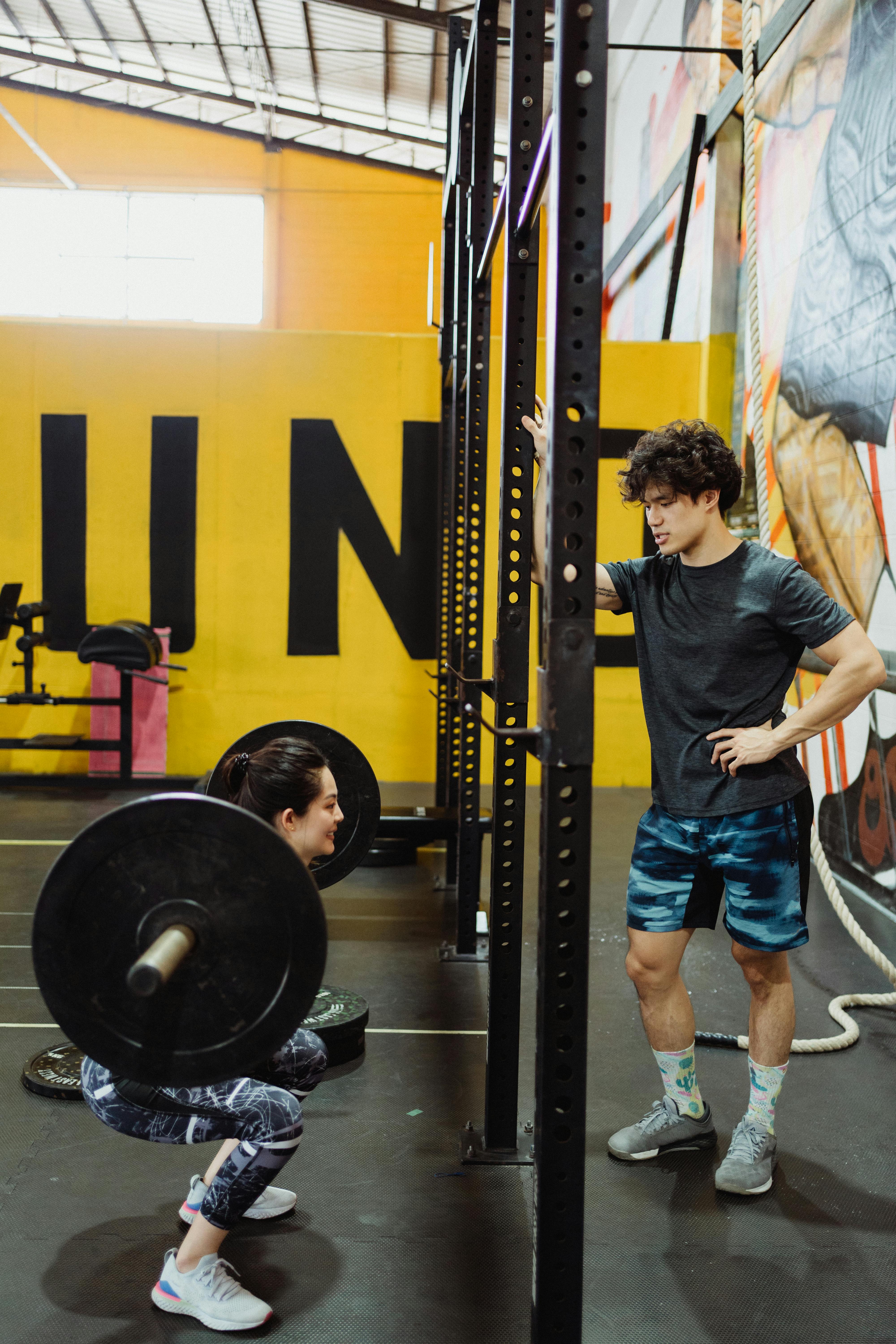
Key Takeaways
- The squat's sticking region happens when quad activity is already dropping but the glutes and hamstrings haven't fully taken over yet, a timing gap identified in EMG research on trained lifters (Larsen et al., 2021).
- Squatting to full depth produced significantly greater strength (effect size 0.56) and lower-limb hypertrophy (effect size 0.88) than partial-depth squatting in a 2021 meta-analysis (Pallarés et al., 2021).
- Competitive powerlifters gain squat strength faster than bench press in absolute terms, roughly 20 to 25 kg a year versus 10 to 13 kg a year for bench, so a squat plateau that feels stubborn is often still a slower patch in a faster-moving lift (Latella et al., 2022).
- Weekly volume, not just intensity, drives most of the hypertrophy that eventually shows up as squat strength; a plateau is often a volume problem in the muscles behind the lift, not the lift's programming itself.
- Work through mechanics, depth and the sticking region, before you touch volume, frequency, variation, or recovery.
Why the Squat Plateaus in the Same Spot, Almost Every Time
The squat has a well-documented "sticking region," roughly a third of the way up from the bottom, where the biomechanics briefly work against you. That's why a squat can visibly die at the same height on almost every failed attempt. It isn't random. It's a predictable mechanical low point.
A 2021 study measured kinematics, kinetics, and muscle activity (EMG) in trained lifters performing heavy 3-rep-max squats. It found that the demand on the hip extensors rises sharply through the sticking region, right as glute activity is still comparatively low, a timing mismatch between when the hips are needed most and when they actually show up to do the work (Larsen, Kristiansen & van den Tillaar, Frontiers in Sports and Active Living, 2021).
It's like a relay race handoff. The quads carry the baton out of the hole, but if the glutes and hamstrings are slow to grab it as the quads fade, there's a dead zone where nobody is really driving the bar.
Competitive powerlifters gain squat strength faster, in absolute terms, than they gain bench press strength: roughly 20 to 25 kilograms a year on the squat, versus 10 to 13 kilograms a year on the bench (Latella, Owen, Davies, Spathis, Mallard & Van Den Hoek, Medicine & Science in Sports & Exercise, 2022). Worth keeping in mind while you work through this: a squat plateau that feels stubborn is often still a slower patch in what is, overall, a faster-moving lift.
The Squat Plateau Decision Tree
Work through these seven checks in order. The first two are squat-specific; the rest are the same checks that apply to any stalled lift, applied here to the muscles and mechanics behind the squat.
Step 1: Depth consistency. Has your squat depth crept shallower over time?
A systematic review and meta-analysis of range-of-motion training found that full range-of-motion squatting produced significantly greater strength gains (effect size 0.56, p=0.004) and lower-limb hypertrophy (effect size 0.88, p=0.027) than partial range-of-motion training (Pallarés, Hernández-Belmonte, Martínez-Cava, Vetrovsky, Steffl & Courel-Ibáñez, Scandinavian Journal of Medicine & Science in Sports, 2021).
Depth quietly creeping shallower as the weight climbs is common, and confidence in the bottom position tends to drop right when a heavier bar makes that shortcut tempting. If that's happened to you, the "plateau" may partly be that you're now doing a different, less productive exercise than the one that was progressing before.
Letting your squat depth creep shallower as the weight goes up is like quietly shortening a race every time it gets hard. The finish line moved, so of course the time looks better, but you're not actually running the same race anymore.
Check it: film a working set from a consistent side angle and compare it to footage from a few months back. If depth has stayed consistent, move to step 2.
Step 2: The sticking region. Where, specifically, does the bar slow down or stop?
Go back to the timing gap described above: if the bar consistently stalls at the same height, roughly a third of the way up, that's the classic hip-extensor handoff gap, not a random weak point (Larsen, Kristiansen & van den Tillaar, 2021).
That points toward accessory work that targets hip extension strength through that specific range, posterior-chain work like heavy hip thrusts, Romanian deadlifts, or good mornings, rather than more generic "squat more" advice. Keep this qualitative: it's a direction to explore, not a prescribed program.
If depth is inconsistent, fix that first. An inconsistent bottom position makes it impossible to tell whether the sticking point is actually in the same place every time.
Step 3: Effort. Are your heavy squat sets actually as hard as logged?
A 2023 systematic review and meta-analysis on proximity to failure found that momentary failure training showed no significant hypertrophy advantage over stopping a couple of reps short (Refalo, Helms, Trexler, Hamilton & Fyfe, Sports Medicine, 2023). That doesn't mean failure training is required to break a plateau, but it does mean the useful question is whether your logged effort matches how the set actually felt.
If your logged reps in reserve consistently doesn't match how heavy squat sets felt in the moment, that's worth checking before you change anything about the program. See how to use reps in reserve to drive progress for the full method.
Step 4: Volume. Is quad and posterior-chain volume enough to keep driving the lift?
There's a graded, dose-response relationship between weekly hard sets and muscle growth: more weekly sets tends to help, up to a point (Schoenfeld, Ogborn & Krieger, Journal of Sports Sciences, 2017). Applied to the squat, that means the muscles doing the work, quads and posterior chain, need enough weekly volume to keep adapting, not that the squat itself simply needs more or fewer sets.
If weekly hard sets for quads and posterior chain have quietly dropped, common when a program shifts focus toward upper body or another lift, that's a strong candidate for the stall. See how many sets per muscle per week actually works for the full range.
Step 5: Frequency. Is one heavy squat session doing too much at once?
Frequency itself usually isn't the real lever here; fitting the volume in well is. If your entire weekly quad and posterior-chain workload gets crammed into a single heavy squat day, splitting that same volume across two sessions can make each one more recoverable, without adding a single set.
Step 6: Exercise variation. Have you actually repeated the same squat variation long enough to see a trend?
Switching between high-bar and low-bar, or front squat and back squat, every few weeks makes it mechanically impossible to tell whether any one of them is actually progressing. That's a measurement problem, not a ranking of which variation is "better." See why random exercise variation makes plateaus harder to diagnose for the deeper version of this problem.
Step 7: Recovery and program length. Is fatigue masking real progress, or has the current progression scheme run its course?
Check for a recent deload before concluding the program itself needs restructuring, and check whether other lifts are stalling at the same time. If the squat is the only thing stuck while everything else keeps moving, that points away from general fatigue and back toward the squat-specific checks above. See when to take a deload and what should actually change for the full breakdown.
What Not to Do When Your Squat Is Stuck
Two overreactions cause more damage than the plateau itself.
- Changing depth or bar path every single session. A real trend takes a few consistent weeks to show up. Adjusting your setup after every session means you're never actually testing the same lift twice, so you can't tell what worked.
- Adding heavy squat volume on top of unresolved fatigue. If step 7 pointed toward accumulated fatigue, piling on more heavy sets right now makes that worse, not better. Fix the fatigue first.
- Switching squat variations to "fix" a plateau without giving any one of them time. High-bar, low-bar, front squat: none of them is inherently better than the others. Jumping between them every few weeks just resets step 6, over and over.
Putting It Together
Run the seven-step tree once against your last month of squat sessions, starting with depth and the sticking region since those two are squat-specific and the cheapest to check. Move through effort, volume, frequency, and exercise variation next, and look at recovery and program length last.
Depth consistency, logged reps in reserve, and weekly volume for the muscles behind the squat are exactly the kind of pattern a real training log makes visible, which is what myoxin's weekly review is built to surface. See how the weekly review works for the mechanics.
The same seven-step logic applies to any stalled lift, with different mechanics at steps 1 and 2. See how to break a bench press plateau and how to break a deadlift plateau for the versions specific to those lifts.
The Takeaway
Most squat plateaus live in the bottom third of the lift, where your hips have to take over from your quads. If that handoff is late or weak, that's usually your answer before you touch your program.
Check depth first, then the sticking region, then effort, volume, frequency, exercise variation, and recovery, in that order. The cheap checks come before the disruptive ones, and most readers will find their answer in the first two or three.
A few weeks of consistent logging, including depth notes and exactly where the bar stalls, is the fastest way to run this tree for real instead of guessing at it.
References
- Larsen S, Kristiansen E, van den Tillaar R. New Insights About the Sticking Region in Back Squats: An Analysis of Kinematics, Kinetics, and Myoelectric Activity. Frontiers in Sports and Active Living. 2021;3:691459. frontiersin.org/articles/10.3389/fspor.2021.691459 Hip extension demand rises sharply through the squat's sticking region while glute EMG activity stays comparatively low, a timing mismatch that drives the sticking point.
- Pallarés JG, Hernández-Belmonte A, Martínez-Cava A, Vetrovsky T, Steffl M, Courel-Ibáñez J. Effects of range of motion on resistance training adaptations: A systematic review and meta-analysis. Scandinavian Journal of Medicine & Science in Sports. 2021;31(10):1866-1881. pubmed.ncbi.nlm.nih.gov/34170576 Full range-of-motion training produced significantly greater strength (ES 0.56) and lower-limb hypertrophy (ES 0.88) than partial range-of-motion training.
- Latella C, Owen PJ, Davies T, Spathis J, Mallard A, Van Den Hoek D. Long-Term Adaptations in the Squat, Bench Press, and Deadlift: Assessing Strength Gain in Powerlifting Athletes. Medicine & Science in Sports & Exercise. 2022;54(5):841-850. pubmed.ncbi.nlm.nih.gov/35019902 Competitive powerlifters gained roughly 20.2-25.4 kg a year on the squat versus 10.5-12.8 kg a year on the bench press.
- Schoenfeld BJ, Ogborn D, Krieger JW. Dose-response relationship between weekly resistance training volume and increases in muscle mass. Journal of Sports Sciences. 2017;35(11):1073-1082. pubmed.ncbi.nlm.nih.gov/27433992 A graded dose-response relationship between weekly hard sets and hypertrophy, supporting the volume check for a squat plateau.
- Refalo MC, Helms ER, Trexler ET, Hamilton DL, Fyfe JJ. Influence of Resistance Training Proximity-to-Failure on Skeletal Muscle Hypertrophy: A Systematic Review with Meta-analysis. Sports Medicine. 2023;53(3):649-665. pmc.ncbi.nlm.nih.gov/articles/PMC9935748 Training to momentary failure showed no significant hypertrophy advantage over non-failure training, supporting the effort check over a failure requirement.